AI photo restoration: what it repairs and what it invents
Upscaling a damaged portrait produced a sharp, convincing face. Comparing it to a second print of the same photograph showed it was not quite the right face.
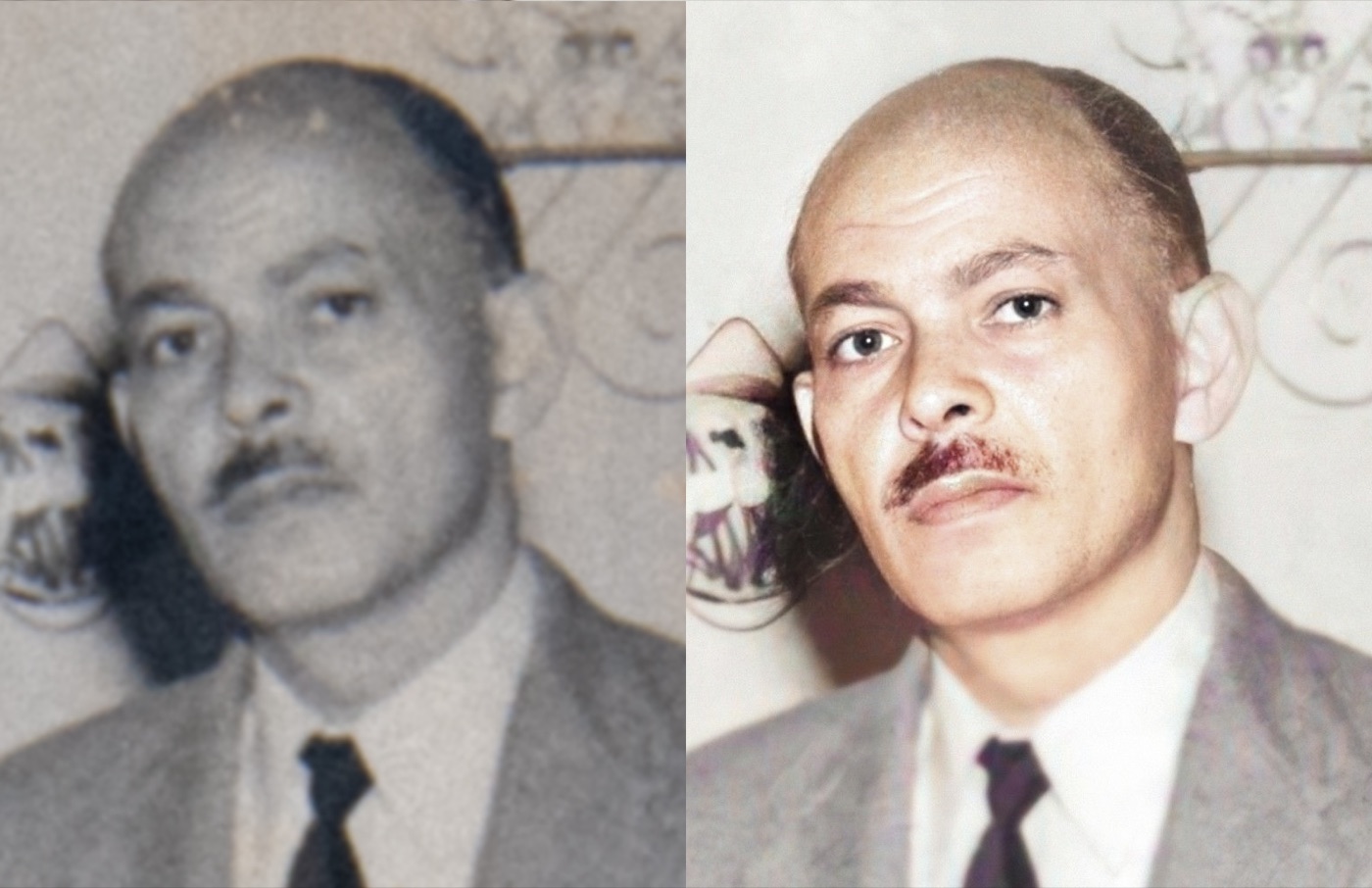
I had a water-damaged portrait, roughly 1911, with the left side of the face largely gone. I ran it through a restoration tool and got back something remarkable: a clean, sharp, entirely plausible photograph of a man looking directly at the camera.
Some months later a cousin sent me a second, undamaged print of the same sitting.
The restored face was not his face. Close, in fairness: same build, same hair, same era. But the mouth was wrong, the eyes were set differently, and the expression had been smoothed into something more pleasant than the original, which was rather stern.
What these tools are actually doing
Restoration models do not recover lost information. There is no information in a water-damaged emulsion to recover. What they do is generate the most probable pixels given everything else in the frame and everything in their training data.
For a scratch across a jacket, that is close to miraculous and essentially harmless, because the probable answer and the true answer are the same. For a missing eye, the probable answer is an average of a million other eyes.
The output is not a photograph of your ancestor. It’s a photograph of a plausible person who resembles your ancestor.
Where the line falls
Safe, and genuinely worth doing:
- Dust and scratch removal
- Tear repair in flat areas: sky, wall, fabric
- Contrast and fade correction
- Modest upscaling of an already-sharp image
Not safe:
- Reconstructing any part of a face
- “Enhancing” a blurred face into a sharp one
- Colourising, if the result will be presented as documentary
- Anything where the model is filling a region rather than cleaning one
The rule I use now
Never overwrite the original, and never circulate a restoration without saying so.
Both halves matter. The first is obvious. The second is the one people skip, and it’s how an invented face enters a family archive permanently. Someone posts a beautiful restored portrait to a family group, it gets saved forty times, and within a year it is the canonical image of a person it does not depict.
I now keep three files for any restored image: the raw scan, the restoration, and a plain text file next to them saying what tool was used and what it changed.
Colourisation deserves its own warning
Colourisation is entirely invention. Every colour in the output is a guess. The models are reasonable about skin and sky and consistently wrong about clothing, which is often the thing carrying the actual historical information: a uniform, a mourning dress, a regional pattern.
Enjoy them. Frame them, even. Just don’t file them as evidence.
And then people make the photo move
The next step past restoration is photo-to-video. You feed in one still portrait and get back a short clip of your ancestor turning their head, blinking, sometimes talking. It is genuinely startling the first time, and the appeal for family history is obvious. Everyone wants to see their great-grandmother move.
It is also the same problem as restoration, turned up considerably.
Restoration invents pixels in one frame. Animation has to invent a face across hundreds of frames, from angles the original photograph never captured. Nobody knows what that woman looked like in three-quarter profile, because the only evidence is one flat portrait taken from the front. So the model decides. Every frame after the first is a guess about a person it has never seen.
A worked example doing the rounds. In July 2026, a well-followed genealogy account, The Technical Genealogist, posted that Gemini had stopped holding faces true to the source photo in photo-to-video work. They said they went back to examples that had worked previously, could not reproduce them, and found that faces shifted noticeably even with careful prompting. They reported HeyGen still doing its job for the narrator use case, meaning a talking historical figure delivering lines, which is a slightly different task.
Worth reading that as one experienced person’s observation rather than a benchmark, which is how they framed it themselves. But the responses suggested plenty of others had noticed the same drift.
The caveat they added is the important part. These models change constantly. Something that works this month may not next month, and may quietly start working again after that. Any specific verdict on a specific tool has a shelf life measured in weeks, this post included.
What does not have a shelf life is the underlying point. A system generating motion from a single still is inventing everything it cannot see, and that is true regardless of which model is currently best at hiding it.
So the rule is the same as the rest of this post, only firmer. Label animations as animations, every time, without exception. A clip of a dead relative talking, shared into a family group with no label, is how an invented likeness quietly becomes the face everyone remembers. At least a colourised photo is still recognisably a photograph. A video of someone saying words they never said is a different category of thing, and it deserves to be marked as one.