Three open-source family history tools that don't do the same job
Gramps Web, Charted Roots and a Claude research skill get compared as rivals. They aren't. They sit at three different layers, and picking by feature list is how people end up with the wrong one.
Search for open-source genealogy software and you get a list, ranked, as if the entries were interchangeable. Three of them come up a lot and are genuinely worth knowing about. Comparing them by feature count misses the point though, because they work at different layers.
One is a system of record. One is a way of working inside notes you already write. One doesn’t store anything at all.
Quick note on how this was put together: it’s an orientation based on each project’s documentation, source and repository activity. It is not a hands-on bake-off. Where I say what something does, that comes from the project’s own docs. I haven’t run a controlled comparison, so don’t read anything below as measured performance.
The short version
| Gramps Web | Charted Roots | Family History Research Skill | |
|---|---|---|---|
| What it is | Self-hosted web genealogy system | Obsidian plugin | A Claude skill |
| Layer | System of record | Working environment | Research method |
| Licence | AGPL-3.0 | MIT | MIT |
| Language | JavaScript (Lit) | TypeScript | Markdown |
| Stars / forks | ~1,550 / 240 | ~147 / 15 | ~96 / 11 |
| First commit | Nov 2020 | Nov 2025 | Oct 2025 |
| Stores your data? | Yes | Yes, as markdown | No |
| Needs | A server | Obsidian | Claude |
Repository figures read from the GitHub API on 26 July 2026. All three were active within the previous six weeks.
Gramps Web, the system of record
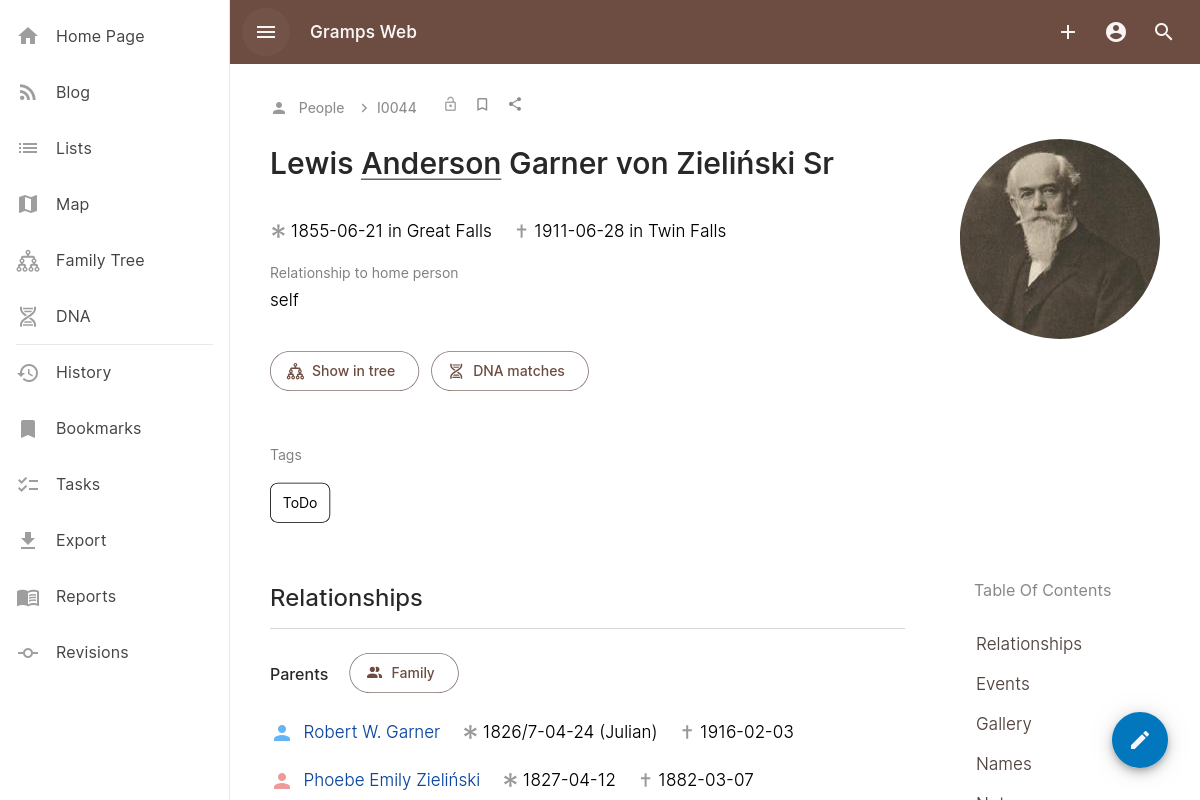
Gramps Web is the web companion to Gramps, the long-running open-source desktop genealogy app. It’s the oldest of the three by a wide margin and the most established. It syncs both ways with the desktop app rather than replacing it.
The documented feature set is broad: ancestor, descendant, fan and hourglass charts, interactive maps with historical overlays, full-text search across record types, DNA and chromosome tools, an integrated blog for writing research up in place, 40-plus languages, and an AI chat feature for asking questions of your own tree.
The real cost here is operational. This is software you host yourself. There’s a public demo you can click through without installing anything, which is what I’d do first, but running it properly means a server you maintain and back up. That’s a genuine barrier. It’s also exactly why the data stays yours.
Go with it if you want one authoritative database, a few relatives contributing, and no subscription. Skip it if running a server isn’t something you want in your life.
Charted Roots, genealogy inside your notes
Charted Roots takes a different position. Your family history lives as markdown notes in an Obsidian vault, linked the way you’d link anything else, and the plugin adds the genealogical machinery on top.
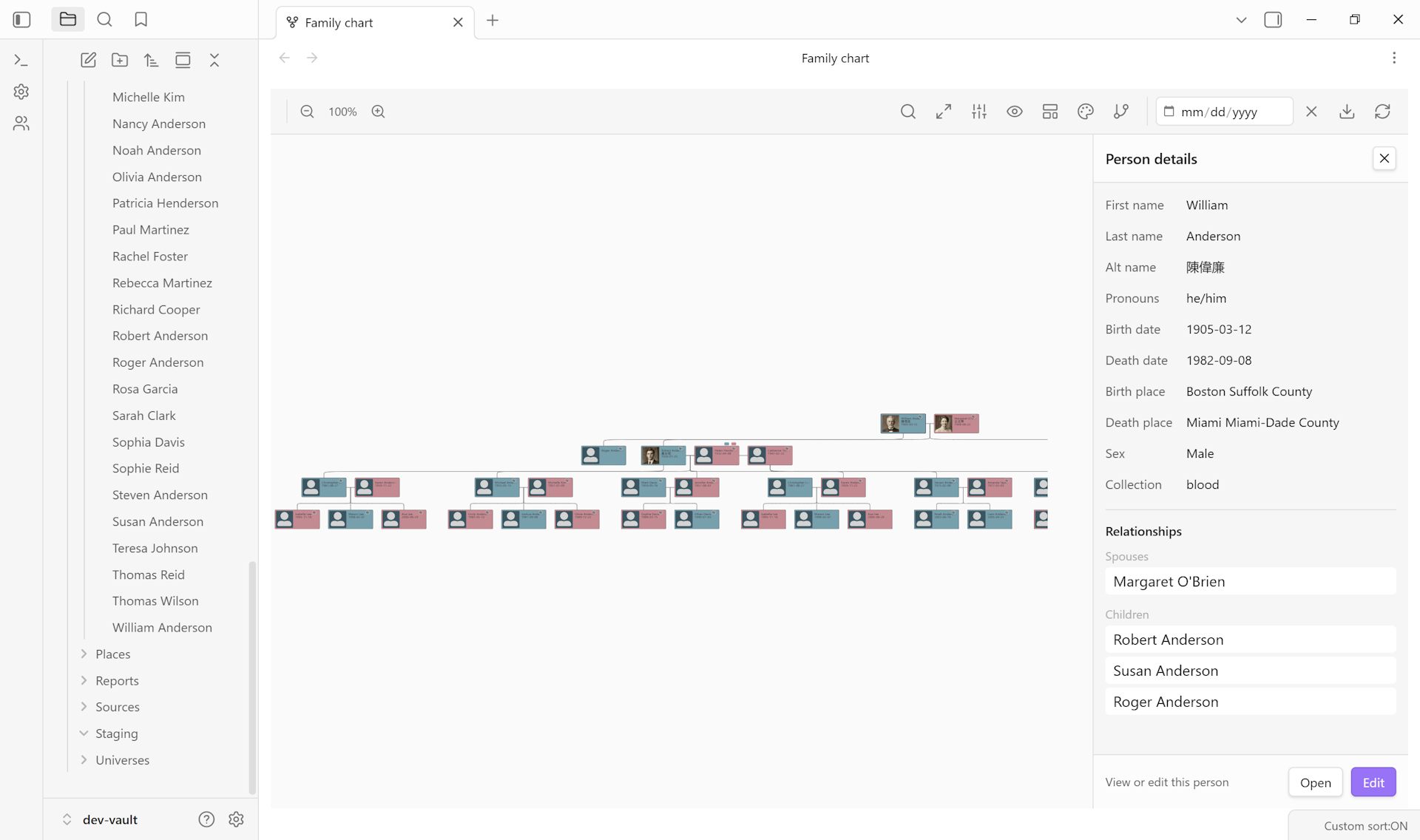
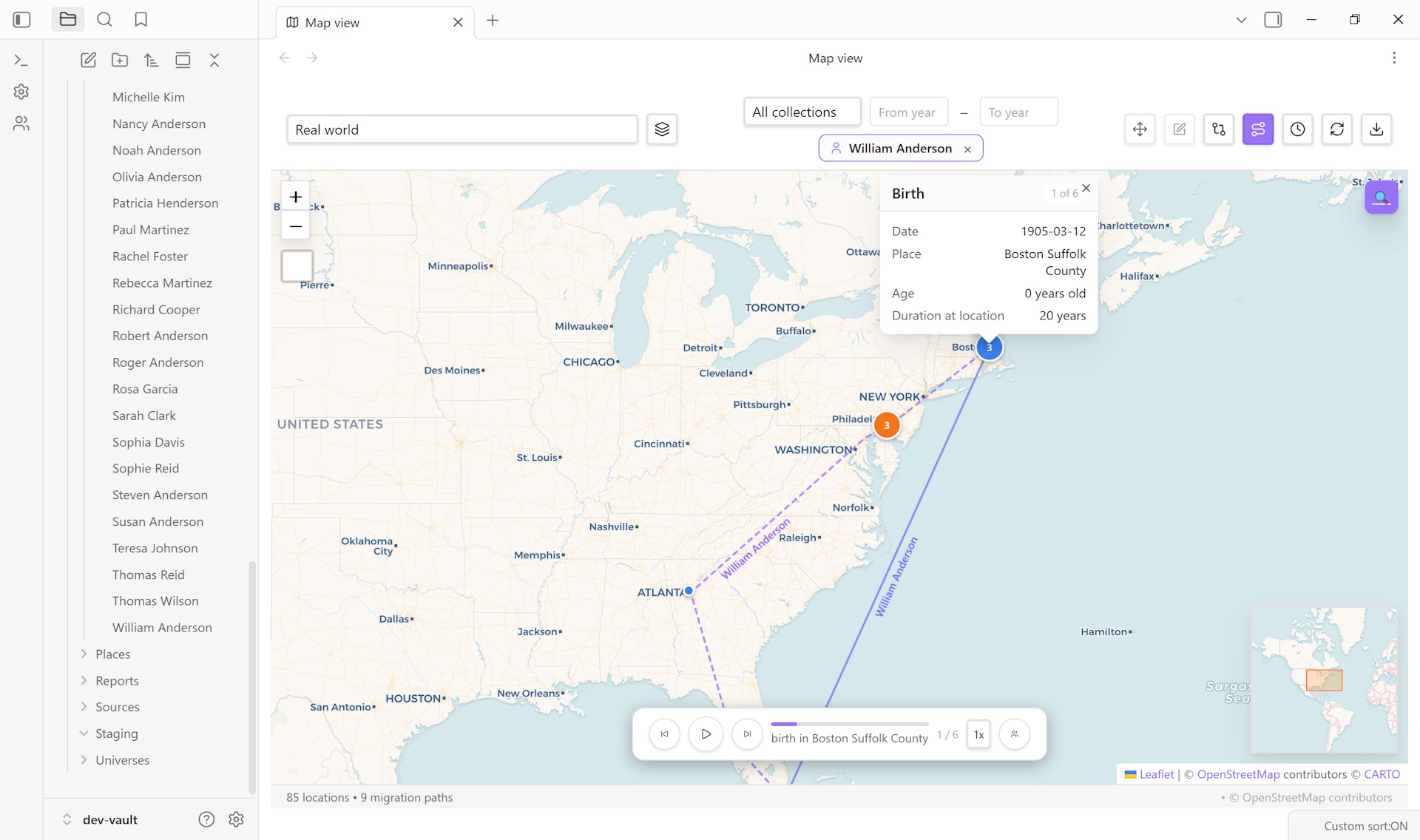
It imports GEDCOM 5.5.1, GEDCOM X and Gramps XML, and exports back out again. That matters, because it means this isn’t a one-way door. The reporting side is unusually deep for a plugin: seventeen report types, a book builder that compiles reports and notes into a single PDF with contents and index, evidence tracking built around the Genealogical Proof Standard, and map views with migration paths and time animation.
There’s also a worldbuilding strand, with custom calendars and fictional place categories, aimed at novelists rather than genealogists. Harmless if you don’t need it.
Two honest caveats. It’s young: first commit November 2025, and still on a 0.x version number, which by normal convention means the developer reserves the right to change things. And it only makes sense if you already use Obsidian, or want to.
Go with it if you think in notes and want the research sitting beside everything else you write. Skip it if you’d be adopting a whole note-taking system just to get at the plugin.
The Family History Research Skill, method rather than storage
This one is the odd one out, which is what makes it interesting. It stores nothing and displays nothing. It’s a set of markdown instructions and templates that teach Claude how to help with the thinking part of research.
What it covers, per its docs: structured research plans, citation formats for fourteen-plus source types, evidence analysis with conflict-resolution frameworks, and research logs that record negative results as well as positive ones. It’s built around the Genealogical Proof Standard and Evidence Explained citation methodology, so it’s aimed squarely at the part beginners skip, which is proving things rather than just collecting them.
The thing that raised my opinion of it: the README opens with a privacy warning instead of a feature list. It’s explicit about not feeding AI systems information on living or recently deceased people, about redacting before sharing, and about verifying everything against primary sources. It cites the Coalition for Responsible AI in Genealogy.
That’s the correct order of priorities and it’s rarer than it should be. A tool that leads with its own limitations is usually one somebody has actually thought about.
Go with it if your problem is method, meaning you have records piling up and no system for evaluating them. Skip it if you don’t use Claude, or if what you really need is somewhere to put the data.
They stack
Here’s the framing that makes these easier to think about: they aren’t alternatives.
A plausible setup is Gramps Web as the database of record, Charted Roots for writing and chart-making against a Gramps XML export, and the research skill for planning and citation discipline as you go. All three read or write standard interchange formats, all three are open source, and none of them locks your data behind a subscription.
The one thing worth deciding up front is where your authoritative copy lives. Two systems both thinking they’re the master is how people end up with two diverging trees and no idea which one is right. Pick the system of record, then treat everything else as a view onto it.
Not sponsored, no affiliate links, no relationship with any of these projects. Repository data was read on 26 July 2026 and will drift, so check the projects themselves before you decide anything.